
Why I'm Not a Christadelphian. Three Reasons.
A Response to Bible Feed
Introduction
I recently chanced upon a video by Bible Feed, a Christadelphian organisation from the UK, entitled I’m a Christadelphian. Here’s why. Discover three of my top reasons. It struck me as a good opportunity to discuss some interesting reasons why I am not a Christadelphian––based around the three top reasons why Dan Weatherall, the presenter of the video, is.
(This is not, I must emphasise, a critique of Dan Weatherall but of the Christadelphian faith.)
His three reasons are summarised usefully at the top end of the video:
- “Christadelphian teaching aligns with the Bible.”
- “Christadelphians have a truth-seeking heritage.”
- “Christadelphians are structured on the New Testament church.”
In my characteristically winsome style, I intend to address these points as follows:
- Christadelphian teachings are unbiblical and sometimes anti-biblical.
- The Christadelphian “truth-seeking heritage” makes an idol of human reason.
- Christadelphians are not structured on the New Testament church.
These are harsh words, but I believe I can defend them. Before I do so, however: a word in response to the very beginning of the video.
“I’m a Christian”
I’m a Christian. And more specifically, I’m a Christadelphian. (0:00)
For context, I am a Reformed Christian. I grew up a Christadelphian and then converted to Christianity once I believed the true gospel message. You can read about it here. Knowing the pain that accompanied my conversion to Christianity makes it difficult to view the above statement at all favourably.
Statements like the above function to present an accessible, normalised version of the Christadelphian faith. To grant it a room in Lewis’s hallway. To pull up a seat at the table, smiling awkwardly. Indeed, throughout the video, Weatherall refers to Christadelphian communities as ‘churches,’ despite the fact that Christadelphians have historically distanced themselves from this word due to its association with Christendom.
Here is Robert Roberts, a man second only to John Thomas in his founding significance to Christadelphians:
“Church”… has become objectionable through association with un-apostolic ideas and institutions… In the same way, “Christian” has become inexpressive, as the definition of a true believer… In our day, it means an inhabitant of Christendom, without reference to individual faith or practice.
The Ecclesial Guide
John Thomas, a man who once said “I would rather be a Moslem than a Papist” (Elpis Israel), had a sharp polemical pen when writing about Christendom. He said:
They are truly in a Laodicean state, and already spued out of the mouth of the Lord.
Elpis Israel, Preface
Despite later in the video expressing love for the Christadelphian heritage, Weatherall clearly does not cling to vintage Christadelphianism as it is still practiced in many ecclesias, including the one in which I grew up.
It is worth noting, therefore, that the Christadelphian faith presented by Bible Feed is not historic Christadelphianism. In approach and emphasis they are frankly miles apart.
Now, lest I commit the genetic fallacy: this is no devastating logical blow to Weatherall’s beliefs. It does very little to argue against their objective merits. Nor does it deny that Weatherall is accurately presenting the modern-day form of the Christadelphian faith in many, perhaps most, parts of the world. But I think it is worth noting that this form is virtually unrecognisable from its roots; and a faithful account of the “Christadelphian heritage” would recognise this.
1. Christadelphian Teachings Are Unbiblical, Sometimes Anti-Biblical
Repeating a line common among adventist religions that sprung up in the 1800s, Weatherall claims:
Everything we believe as Christadelphians comes from the Bible. (3:16)
This, as I will show, is not entirely false. Most of their beliefs are ostensibly sourced from the Bible—Christadelphians cite nothing else as their final authority. But they are ‘from the Bible’ in the same sense that a literature professor might draw feminism ‘from The Odyssey.’ It’s not actually there; but confirmation bias is a powerful tool that can bend a text into any shape, given enough elbow grease.
The following is a short perusal of such beliefs, in no particular order. They do not attempt to exhaustively span the breadth of Christadelphian doctrine; rather, they are emblematic of a pattern of unbiblical reasoning that pervades it. Each one is perfectly, quintessentially, classically Christadelphian in its unembarrassed sophomoric clunkiness.
The Devil and Demons Don’t Exist
According to Christadelphians, the devil is usually nothing more than a personification of sin. Those more acquainted with their faith will be more specific: the devil personifies the evil heart of man as the source of sin. When Scripture speaks of “Satan,” moreover, it is identified with many and varied personal ‘adversaries’—Judas Iscariot, the Law of Moses, Pagan government, Sanballat and Tobiah, God Himself, or even a righteous angel. Indeed, although it is purportedly the context that determines the identity of Satan, the only real limiting factor I can detect on who he may be seems to be: ‘not a sinful angel; anything but that.’
Behind this unusual doctrine is the notion that angels cannot sin, a position I find untenable when Scripture refers to “angels who sinned” (2 Peter 2:4).
| Christadelphian Teaching | The Bible |
|---|---|
Angels cannot sin | "Angels who sinned" |
So the doctrine itself—that “Satan” is a common, local adversary—crumbles under the weight of commonsense reading of Scripture:
Put on the full armor of God, so that you will be able to stand firm against the schemes of the devil. For our struggle is not against flesh and blood, but against the rulers, against the authorities, against the world forces of this darkness, against the spiritual forces of wickedness in the heavenly places.
Ephesians 6:11-12
The fact that Christadelphians deny the existence of “spiritual forces of wickedness in the heavenly places” makes such a doctrine blatantly unbiblical. What language could Paul have used to be any clearer?
Here is another verse that, to put it mildly, presents difficulty to Christadelphians:
But Michael the archangel, when he, disputing with the devil, was arguing about the body of Moses…
Jude 9
Who except a sinful angel was arguing with Michael the archangel about the body of Moses?
Not much more can be said for the Christadelphian claim that demons are simply mental illnesses. The argument is usually stated as follows:
Some diseases were understood, others, particularly those which changed behaviour were not understood and so the sufferers were said to have a demon or evil spirit that made them act in that way. But we see from Matthew’s words that Jesus healed them all. Demon spirits did not really exist.
Demons were a sign of a greater problem.
If demons did not exist, why did Jesus act and talk as if they did? He used the language and wrong beliefs of the people to teach a great truth…
All of us have a disease that eventually will kill us… This is a healing that we all need and which is available to everyone who believes in Jesus as his saviour.
Basic Bible Truths: Demons and Evils Spirits, Christadelphian Bible Mission
The danger here is that part of this is very true: demons were a sign of a greater problem; they did point to the fact that we all require healing. But this does not explain why Jesus would acknowledge and work within the framework of demonology—certainly not if rejecting the existence of demons is a “basic Bible truth.” The basic Bible truth, to the contrary, is that demons are in the Bible from top to bottom and assumed as existing by the writers of the New Testament. Consider this verse, for example:
You believe that God is one. You do well; the demons also believe, and shudder.
James 2:19
Notice James does not refer to “demoniacs” but the demons themselves. What are these demons? Do mental illnesses believe in God? What eisegetical nonsense is this?
Having been a Christadelphian myself for 23 years, I know how I would have explained away these verses: I would treat the text of Scripture as a code to be unravelled rather than plainly saying what it means. “The devil” isn’t really a devil; “demons” aren’t really demons; “the body of Moses” isn’t really the body of Moses; “spiritual forces in heavenly places” aren’t really spiritual forces in heavenly places; the “angels” who sinned weren’t really angels; and there was no real argument with Michael the Archangel—it’s just a manner of speaking.
Wherever this doctrine comes from, it’s not the Bible.
Haruspical Tomfoolery
By that title I mean: fundamentally ridiculous attempts to divine the future from arbitrary signs. It is unfortunately an apt description of Christadelphian attempts to predict the return of Christ, as I will demonstrate.
Now, if you asked a Christadelphian, “Can we know when Christ will return?” they will likely answer along these lines:
The apostles also acknowledged that they could not know the precise time… There would be general indications available — what Paul calls ‘times and seasons’ — which would help keep the believers prepared.
Christ is Coming!, The Christadelphian Office
It’s a fair answer to a fair question, accurately representing the reasonable side of Christadelphian eschatological thought. ‘No, we can’t know precisely; but we can get a general idea.’ It is for this reason that Christadelphians are generally hesitant to set dates of Christ’s return.
It does not, however, seem to slow them down in setting other dates—dates which do everything but predict the return of Christ itself. Such date-setting is particularly difficult to avoid under the Christadelphian understanding of the Book of Daniel. Consider this passage:
None of the wicked will understand, but those who have insight will understand. But from the time that the regular sacrifice is abolished and the abomination of desolation is set up, there will be 1,290 days. How blessed is he who keeps waiting and reaches the 1,335 days!
Daniel 12:10-12
The difficulty is not that under some interpretations the text appears to predict the end times. The difficulty is the fact that only those who have insight will understand. And to the Christadelphian faith—a movement historically claiming ‘we alone have recovered the truths lost by Christendom’—this has historically been a difficult pill to swallow. They, if anyone, ought to know the meaning of the 1,335 days.
Robert Roberts makes this exact point:
We refer to the words addressed to Daniel: "None of the wicked shall understand, but the wise shall understand" (Dan. xii, 10). This would imply not only that uprightness is necessary, but also that the matter is not communicated in such a form as to be apprehended on the surface of it, but requires the qualification of "wisdom" to elucidate the hidden meaning… In view of this, we need not be surprised at the mistakes that have from time to time been made in the interpretation of the times and seasons. Numberless and outrageously absurd theories have, in all ages of the world, been put forward on the strength of what is written on times and seasons. Dates have been fixed, and events predicted which time has falsified.
Christendom Astray
Unfortunately, this did not age well. I present to you a far-from-exhaustive catalogue of Christadelphian predictions of the fulfilment of Daniel’s 1,335 days, only two of which are yet to be, as Roberts so ably puts it, falsified by time.
| Date | Writer | 1,335 Prediction | Source |
|---|---|---|---|
1845 | John Thomas | 1866 | Herald of the Future Age, Vol 2, p 142 |
1846 | John Thomas | 1866 | Herald of the Future Age, Vol 3, p 112 |
1849 | John Thomas | c. 1865 | Elpis Israel, First Edition, p 373 |
1853 | John Thomas | 1866 | Herald of the Kingdom and Age to Come, 1853, p 197 |
1854 | John Thomas | 1866 | Herald of the Kingdom and Age to Come, 1854, p 144 |
1854 | John Thomas | 1866 | Anatolia, p 93 |
1855 | John Thomas | c. 1865-6 | Herald of the Kingdom and Age to Come, 1855, p 83 |
1859 | John Thomas | 1864 | Herald of the Kingdom and Age to Come, 1859, p 208-209 |
1864 | 'Antipas' | 1909 | Yahweh Elohim, p 8 |
1866 | John Thomas | c. 1868 | Elpis Israel, Fourth Edition, p 428 |
1868 | John Thomas | 1868 | Exposition of Daniel, p 120 |
1868 | John Thomas | 1868-9 | Eureka, Vol 3, p 136-138 |
1869 | Robert Roberts | 1869 | The Ambassador of the Coming Age, Vol 6 |
1877 | Charles Smith | 1877 | The Christadelphian, Vol 14 |
1889 | Unspecified | 1889 | The Christadelphian, Vol 26 |
1891 | E. Waite | 1898 | The Christadelphian, Vol 28 |
1892 | Robert Roberts | 1941-3 | The Christadelphian, Vol 29 |
1893 | Robert Roberts | 1943 | City Hall Lectures, p 32 |
1896 | Robert Roberts | 1941-3 | A Look Round the Troubled World, p 17 |
1916 | C.C. Walker | 1917 | The Christadelphian, Vol 53 |
1927 | C.C. Walker | 1933 | The Christadelphian, Vol 64 |
1944 | G. Jolly | 1945 | Logos, Vol 10, p 237 |
1945 | J. Mansfield | 1941-5 | Logos, Vol 11, p 135 |
1945 | Bruce Philip | 1945 | Logos, Vol 11, p 159-162 |
1945 | H.P. Mansfield | 1943-5 | Logos, Vol 12, p 103-104 |
1957 | A.R.S. | 1957 | Logos, Vol 24, p 10-11 |
1960s? | G.V. Growcott | 1992 | Be Ye Transformed, Vol 3, p 395 |
1973 | R.S. Kirwin | 1992 | Logos, Vol 40, p 94 |
1978 | B. Day | 1978 | Logos, Vol 45, p 76 |
1987 | K.G. Smith | 1992-3 | The Christadelphian, Vol 124 |
1987 | Hubert E. Taylor | 1992 | The Christadelphian, Vol 124 |
2012 | T.R.G. | 2012 | The Christadelphian, Vol 149 |
2020 | Grant Bowden | 2023 | Christadelphian Bible Talks, Daniel, Study 12 - Ch 12 |
2020 | Ray Edgecombe | 2020s | Scripture Scribe, Daniel The Prophet, Class 16 - The Time of the End - How Long |
2020 | Unspecified | 2023-7 | YouTube, Daniel The Prophet: Class 12 ‘The Time of the End How Long’ |
2021 | Unspecifided | 2023 | YouTube, Why are the End Times taking so Long (Daniel 12) #2 Daniel Cpt 12 |
2021 | Barrett Law | 2027 | Scripture Scribe, Daniel — The Tale Of Two Kingdoms, Class 12 - Opening the Books |
2023 | Ken Whitehead | 2023 | Scripture Scribe, The Wise Shall Understand |
2024 | Jim Cowie | 2024 | YouTube, MBCE Wednesday Class 07/08/2024. Bro J Cowie |
It is difficult, of course, to interpret a large table of data at a glance—which is why I have included the following line graph for your perusal:
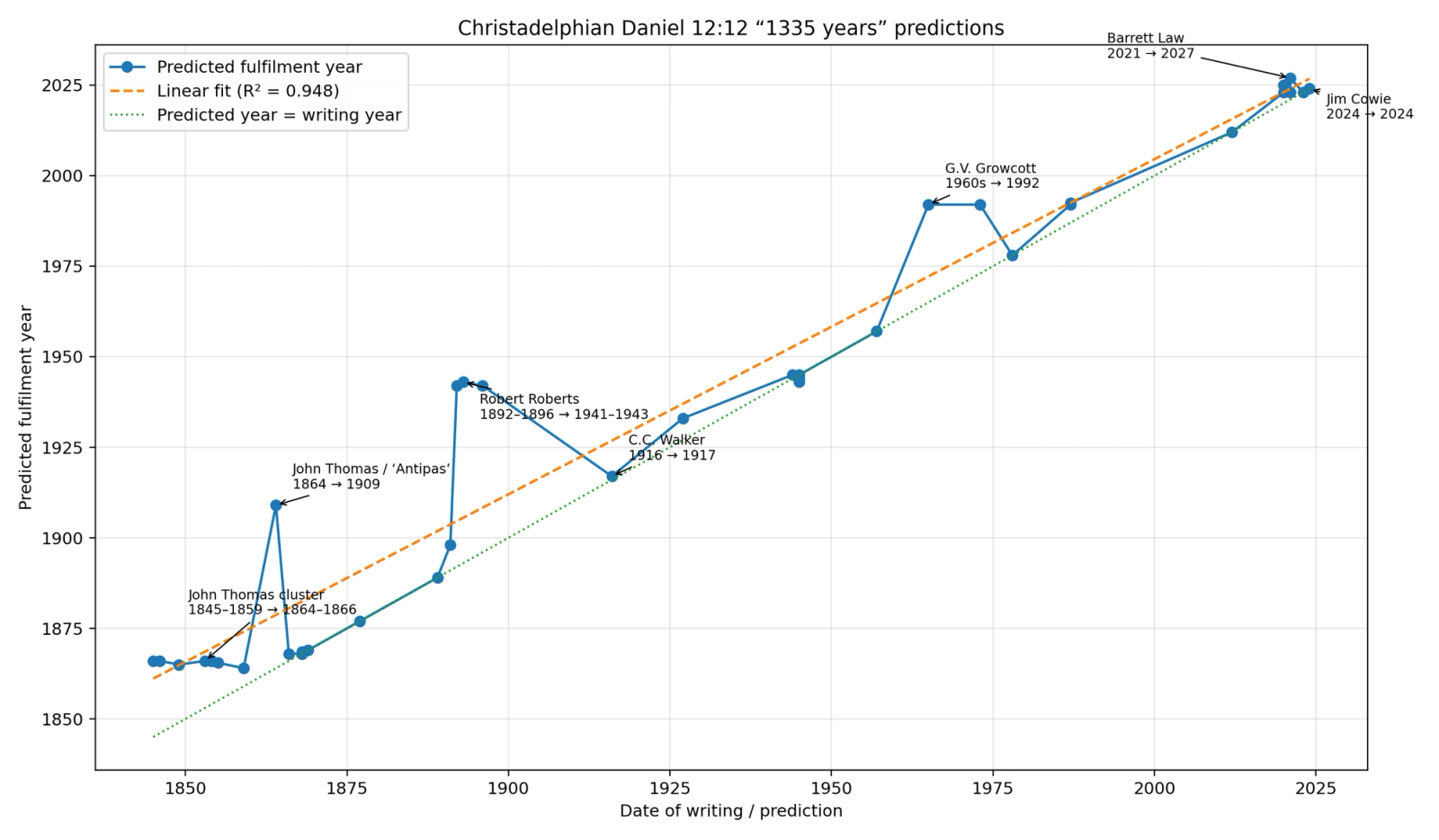
I’m no mathematician, but I know that an R2 = 0.948 is extremely high for a dataset like this. It means a whopping 95% of the variance in the predicted fulfilment year is explained simply by the year in which the prediction was made. In laymen’s terms: the later the interpreter, the later the fulfilment.
Not to put too fine a point on it, this is exactly the opposite of what we would expect if these interpretations were chiefly controlled by a stable reading of the biblical text. If Daniel’s 1,335 days truly predict the end times, and if Christadelphians are “the wise” who would decipher them, we would expect their predictions to converge on one historical endpoint as scholarship improved over time. Instead, the graph ascends at a comically predictable angle and the chronological drift continues.
All this would be somewhat excusable if failed predictions were admitted as being straightforward failures. To the contrary, Christadelphians simply change the meaning of ‘fulfilment’:
- Early interpretations involve the resurrection, the Second Coming, or Daniel literally standing in his lot.
- Later interpretations are more of an exercise in geopolitical rubbernecking about Turkey, Islam, Jerusalem, and the Dome of the Rock.
And should a particularly convincing prediction pass its use-by-date, rather than chuck it out, it is simply relabelled as a partial fulfilment and left to stink in the fridge. Why not just call the milk ‘butter’ and leave it there?
It is a classic ‘ratchet effect’ in which the system survives by redefining what success means after the fact.
Indeed, there is a pattern too consistent to naively dismiss: Christadelphian interpreters repeatedly find the fulfilment of prophecy just over their own horizons. Their calculations seem to find, with suspicious punctuality, that Daniel was chiefly concerned with the interpreter’s own news cycle. If this had occurred for ten, twenty, even twenty-five years, the passage of time alone could not throw significant shade on the interpretations made—maybe the calculations were a decade or two out. But this has been going on for 180 years! The joke’s over, guys!
I do not suppose that many, if any, of these men were insincere. But this is exactly the sort of situation in which self-deception, that haughty menace, flourishes. How else could intelligent men find themselves using lunar Islamic years to interpret the Book of Daniel?
Like it or not, eschatological predictions do not occur down an obscure side alley of Christadelphian thought. They blithely inhabit the metaphorical living room, prominently featuring in the movement’s most important books and magazines ever since the 1840s. And in no universe could they be considered biblical.
Animal Sacrifices Will Be Reinstated
It is worth noting, before jumping into this heading, that although there are a few dissenting voices, what I am about to describe is undoubtedly mainstream, historic Christadelphian teaching that continues to the modern day. What’s more, if you’ll excuse the phrase, everything about it tastes Christadelphian.
Yet it is one of the more devastatingly false Christadelphian teachings—not unbiblical, but anti-biblical. The doctrine states that when Christ returns a temple will be built in Jerusalem the plan of which is detailed in Ezekiel 40-48. This system of government will involve the reinstating of animal sacrifices as a commemoration of the sacrifice of Christ. Roberts says:
[Animal sacrifice is] a performance which was typical under the old covenant, and is again typical under the new, “in lambs and bullocks slain”.
Christ on Earth Again, p. 54
This, again, reveals a Christadelphian belief ostensibly founded in Scripture. Yet a doctrine more contradictory to Scripture could scarcely be written if one schemed for months to devise it. Say the words slowly:
Animal sacrifices in the New Covenant.
Which translation of Hebrews allows for this? The Interpretive Dance Version?
For the sake of completeness: remember that the Book of Hebrews says there are no animal sacrifices in the New Covenant:
This is the covenant that I will make with them… Their sins and their lawless deeds I will remember no more… Now where there is forgiveness of these things, there is no longer any offering for sin.
Hebrews 10:16-18
Remember also this statement from Galatians:
Therefore the Law has become our tutor unto Christ, so that we may be justified by faith. But now that faith has come, we are no longer under a tutor.
Galatians 3:24-25
Given the clarity of the New Testament, I suppose that an error of this importance could only occur when the plain meaning of Scripture comes second to a preconceived eschatological framework. Christadelphians have very rigid ideas and predictions about what the return and millennial reign of Christ will look like—always have––and this eschatological structure always takes precedence over the clearest of New Testament teachings.
If another standard objection be raised—”these sacrifices will not be efficacious for salvation but merely commemorative of Christ’s sacrifice”—the argument is nugatory because animal sacrifices never were efficacious for salvation. They were always a mere foreshadowing of the real deal; that is why they were taken away when said real deal appeared. To argue for the necessity of more types and shadows that point back is to argue that the real deal has again become obscured, contrary to Paul’s insistence that the maturity of the church would bring greater clarity (1 Corinthians 13:12).
As a general rule, Christadelphians insist upon rigid literalism when it comes to difficult prophecies, but explain away many of the clearest, most important teachings of Scripture with the sort of hand-wavy sophistry usually reserved for atheists opining on the hummingbird.
Christ Will Offer Animal Sacrifices For Himself After He Returns
With all of this said, Christadelphians move into even more anti-biblical territory when they claim that Christ is the “prince” mentioned throughout Ezekiel 40-48.(see Christ on Earth Again, p. 33; The ‘Future House of Prayer for ‘all’ Nations’ Ezekiel 40-48, Christadelphian Video; Jim Cowie Bible Marking Notes: Ezekiel 45-48). This may seem a reasonable interpretation until we read words like this:
And on that day the prince shall provide for himself and all the people of the land a bull for a sin offering.
Ezekiel 45:22
Christ offering a sin offering for himself after the Second Coming? Yes. Christadelphians embrace the absurdity:
Christ the Prince will indeed offer a sin offering for himself (Eze. 45:22)…
Ezekiel’s Temple Revisited, p. 48
My incredulity is stated plainly by Roberts himself:
Some such may think it incongruous that the Prince (being Christ and none other) should offer these sacrifices, which include sin-offerings.
Christ on Earth Again, p. 54
Yes, sir. I do think it incongruous. Though somehow “incongruous” understates my thoughts. I would prefer to say that it scours the dregs of foolishness and demotes rational thought to a haunted husk eaten out by the worm that dieth not.
Let me get this straight: Christ will return in glory, immortal and incapable of sin; even so, he’ll find a bull, lead it into a temple and offer it on an altar as a sin offering… for himself.
Reader, this is utter foolishness. It is the frigid limit of folly. It is to wisdom what spilled spaghetti on a bus is to the Mona Lisa.
Hear what the Bible says about Christ, and consider whether it is remotely possible for him to offer an animal sin offering for himself ever, let alone after he returns:
And you know that He was manifested in order to take away sins, and in Him there is no sin.
1 John 3:5
For it was fitting for us to have such a high priest, holy, innocent, undefiled, separated from sinners and exalted above the heavens; who does not need daily, like those high priests, to offer up sacrifices, first for His own sins and then for the sins of the people, because this He did once for all when He offered up Himself.
Hebrews 7:26-27
But now once at the consummation of the ages He has been manifested to put away sin by the sacrifice of Himself… So Christ also, having been offered once to bear the sins of many, will appear a second time for salvation without reference to sin, to those who eagerly await Him.
Hebrews 9:26-28
But He, having offered one sacrifice for sins for all time, sat down at the right hand of God.
Hebrews 10:12
2. The Christadelphian “Truth-Seeking Heritage” Makes an Idol of Human Reason
A moment in Dan Weatherall’s video particularly caught my attention:
Now, the story begins in the 1800s when people involved in restorationist movements were studying their way out of mainstream Christianity. And they realised that the Bible didn't support the typical doctrines of the Trinity, heaven-going, replacement theology, and so on. And these truth seekers were prepared to follow the evidence and forge a path outside of the accepted norms. (7:56)
The assumption behind this statement—and it is a rather spiky assumption—is that if Christians would only study the Bible with an open mind, prepared to follow the evidence, that priceless commodity, wherever it led, they would find themselves in a similar place to, if not actually one of, the Christadelphians.
There are two biting problems with this claim. The first is that it only takes a single credible exception to disprove—and I am at least one such exception. My conversion from the Christadelphian faith to Reformed Christianity occurred somewhat along the lines just described, but in reverse. One might say, to paraphrase:
The story begins in the 2020s when a young man who grew up a Christadelphian was studying his way out of the faith of his parents, grandparents, and great grandparents. He realised that, despite every last member of his family and extended family believing in unitarianism, dispensational-adjacent eschatology, and salvation by works, the Bible actually teaches the Trinity, salvation by grace alone, and the current reign of Christ.
In other words, how do you deal with me? I followed the process you describe; I was a truth seeker; and here I am—a Reformed Christian.
The second problem explains why I ended that paraphrase early. Why did I not say “This truth seeker was prepared to follow the evidence and forge a path outside of the accepted norms”? Because it wouldn’t be true for me, nor is it true for anyone. Here is how I described my conversion in the Australian Presbyterian:
I had not counted the cost. Believing that the Christadelphian positions were correct, I assumed that any amount of macroscopic study would only provide further proof in their favour. When this did not turn out to be the case, I feared the consequences of binding my conscience to a full discovery of the truth. I loved my life as a Christadelphian, and wasn’t prepared to lose it – not even for the truth. So, I put my Bible study on hold, choosing to focus on other, more secular, life pursuits.
The above paragraph is included to dispel any notion that my own study and ingenuity was what brought about my conversion. The old adage about the horse brought to water applies here. Men who are in sinful rebellion against God – as I was – do not want the truth. The truth asks too much. It requires one to turn from slavery to worldly loves – or, to call them what they are: idols – to the difficult freedom of submission to the true and living God. This was a problem of the heart, not just the head.
Christadelphian to Christ, Australian Presbyterian
The deeper problem with the restorationist narrative is that it assumes a view of human nature foreign to Scripture. Men, it claims, are capable of approaching Scripture as neutral investigators, laying aside all prejudice and simply following the evidence wherever it leads. Yet Scripture states that man's greatest obstacle is not ignorance but rebellion:
There is none who understands,
There is none who seeks for God;
Romans 3:11
But a natural man does not accept the depths of the Spirit of God, for they are foolishness to him, and he cannot understand them, because they are spiritually examined.
1 Corinthians 2:14
No one can come to Me unless the Father who sent Me draws him; and I will raise him up on the last day.
John 6:44
Men loved the darkness rather than the Light, for their deeds were evil. For everyone who does evil hates the Light, and does not come to the Light lest his deeds be exposed.
John 3:19-20
Of course, man can know real things about God (Psa 19:1, Rom 1:20), and can even exhibit genuine curiosity and reasoning. He can even hold the truth unwittingly, all the while suppressing it. But the ability to seek and embrace God’s salvific truth is not in him apart from the presence of the Spirit of God.
“Seek, and you will find,” says Christ—and yet men do not because they cannot; and cannot because they do not. They are morally unable. They may “grope” blindly for years in the vain hope of perhaps finding God when all the while “he is not far from each one of us” (Acts 17:27). Hence the Psalmist had cause to say:
When You said, “Seek My face,” my heart said to You,
“Your face, O Lord, I shall seek.”
Psalm 27:8, NASB
Without the grace of God, man's so-called truth-seeking is no more than defiant self-rule. With it, he cannot help but submit.
It is for these reasons that I reject the restorationist narrative that treats the birth of the Christadelphians faith as the fruit of neutral, courageous truth-seeking. “Just me and my Bible” is no more than a recipe for heresy. Yet the problem with it is not the Bible but the “just me.” Clearly, studying the Word for yourself is of great importance (Jn 17:17, Psa 19:7, 2 Tim 3:15-16; Acts 17:11-12). But actually understanding it is a two-pronged gift from God.
First, understanding Scripture can only happen when God Himself opens our minds to grant understanding—that is, when the Spirit is at work:
Yet to this day Yahweh has not given you a heart to know, nor eyes to see, nor ears to hear.
Deuteronomy 29:4
For this reason they could not believe, for Isaiah said again, “He has blinded their eyes and He hardened their heart, lest they see with their eyes and understand with their heart, and return and I heal them.”
John 12:39-40
Open my eyes, that I may behold
Wonderful things from Your law.
Psalm 119:18
Then He opened their minds to understand the Scriptures.
Luke 24:45
Lydia… whose heart the Lord opened to pay attention to the things spoken by Paul.
Acts 16:14
Second, understanding Scripture occurs within the Church, not in isolation from it. I certainly do not mean that everything a church ever says ought to be taken as law; I mean that there is a realm, a sphere, in which God intends the meaning of Scripture to be sought out, and that is the Church. Christ did not leave His people as isolated interpreters, each tasked with reconstructing Christianity from scratch himself. Rather, He gave gifts to the Church for her instruction and preservation in the truth:
And He Himself gave some as apostles, and some as prophets, and some as evangelists, and some as pastors and teachers, for the equipping of the saints… so that we are no longer children, tossed here and there by waves and carried about by every wind of doctrine, by the trickery of men, by craftiness in deceitful scheming.
Ephesians 4:11-14
…the household of God, which is the church of the living God, the pillar and support of the truth. And by common confession, great is the mystery of godliness…
1 Timothy 3:15-16
Paul… wrote to you, as also in all his letters, speaking in them of these things, in which are some things hard to understand, which the untaught and unstable distort, as they do also the rest of the Scriptures, to their own destruction.
2 Peter 3:16
The Christadelphian mistake, therefore, was not that they studied Scripture carefully, nor that they challenged ecclesiastical tradition. These are reformational basics to which I myself, a Reformed Christian, remain indebted. The Christadelphian mistake was in supposing that (a) Christ’s bride had become irreparably defiled, requiring a fresh restart, and that (b) a saving understanding of Scripture required no act of divine will except for the initial writing of the words themselves.
A clear contrast is found in the Reformers. Calvin and Luther, for example, did not say, “Forget the Church; forget the Fathers; forget creeds; forget councils; let every man sit under a lonely tree with his King James Bible and reconstruct Christianity for himself.” They would argue until the cows came home that Scripture stood above all ecclesiastical authorities, to be sure; but they believed Scripture was given to the Church and was to be read within the Church, in conversation with her teachers, confessions, and historic witness.
Calvin puts it this way:
I willingly embrace and reverence as holy the first four councils, namely, Nicaea, Constantinople, Ephesus I, and Chalcedon, together with such others as were held for the condemnation of errors, in so far as they relate to the doctrines of faith. For they contain nothing but the pure and genuine exposition of Scripture, which the holy Fathers, with spiritual prudence, applied to the crushing of the enemies of religion who then arose.
Institutes of the Christian Religion, 4.9.8
Notice that Calvin submits to the councils, recognises their authority, but gives his ultimate reason for doing so as the fact that “they contain nothing but the pure and genuine exposition of Scripture.” While Scripture remains the only infallible authority, other lesser authorities still have weight. Such is the way we look up to any fallible authority—parents, for example. We are instructed to obey our parents, for they are genuine authorities; but we still hold them to the standard of Scripture should the time come for this.
The restorationist “truth-seeking heritage,” so-called, swings far beyond the Protestant submission to Scripture: it idolises the autonomy of the individual; it enthrones the idea that man can reason his way to salvation. These idols must be the first to topple in the life of a Christadelphian. I do not say this as an outsider, peering over my glasses with a sneering ‘huh’ on my nostrils, but as a man who once bowed before these same idols.
You may not truly submit to Christ so long as you believe you are the driving authority in your faith.
3. Christadelphians are Not Structured on the New Testament Church
As the last reason for being a Christadelphian, Weatherall presents the opinion that the structure of Christadelphian churches mirrors that of the New Testament:
…we also have a lay church model. Without any paid pastors or clergy, we’re completely reliant on volunteers… I think this mirrors the New Testament church where we see Christians called to get involved in every aspect of church life… (10:04ff)
We may supplement this description with Robert Roberts’ stipulations in The Ecclesial Guide, one of the most formative Christadelphian documents. He insists:
- That exercising of authority in an ecclesia is “out of the question,”
- That “there must be no authority, only service,” and
- That “mutual consent” is the basis of order.
This, I am afraid to say, does not at all “mirror the New Testament church.” To prove this I will address two claims, neither of which are biblical:
- That New Testament church elders did not exercise authority.
- That New Testament church elders were not paid.
Did New Testament Church Elders Exercise Authority?
This ought to be an open-and-shut case—and would be, were it not for several misinterpretations of Scripture. Consider how clearly the New Testament teaches the authority of elders:
The elders who lead well are to be considered worthy of double honor, especially those who labor at preaching the word and teaching.
1 Timothy 5:17
Obey your leaders and submit to them—for they keep watch over your souls as those who will give an account.
Hebrews 13:17
Notice how Hebrews promotes a model of church eldership comparable to the hierarchy of marriage: just as wives should obey their husbands and submit to them, so laymen must obey their leaders and submit to them. If the word “authority” has any meaning, it is that.
(On a side note, perhaps I could have written a shorter article if I’d been content with the six words, “Why don’tya’jus’ read the Booka Hebrews?”)
The authority of elders is also seen in one of Scripture’s most frequent images: shepherd and flock:
Therefore, I exhort the elders among you… shepherd the flock of God among you.
1 Peter 5:1-2
The Christadelphian lay church model self-consciously collapses shepherd and flock such that there is no true distinction between them. But the office of shepherd communicates a staff-wielding, directive authority—the sort of authority that decides “we’re going over here because it’s safer” and expects obedience from the sheep. I grant that it is a gentle, guiding authority; Peter forbids “lording it over those allotted to you” (1 Pet 5:3).
Note also that the Old Testament refers to the kings of Israel as shepherds, and promises that God Himself will “shepherd His flock, and make them lie down.” (Ezekiel 34:15).
This, of course, is partly why the image is applied to Christ, the Chief Shepherd (1 Pet 5:4). Peter wishes to convey that the authority wielded by Christ Himself is, in measure, represented in the elders who lead the Church. Just as surely as the Chief Shepherd exercises authority over his sheep, so those mortal shepherds exercise authority over theirs. It is not the level of authority I am equating but the fact of its existence—a fact Christadelphians deny.
This shepherding authority is often exhibited in the New Testament:
These things speak and exhort and reprove with all authority. Let no one disregard you.
Titus 2:15
The Holy Spirit has made you overseers, to shepherd the church of God
Acts 20:28
But we ask of you, brothers, that you know those who labor among you, and lead you in the Lord and admonish you, and that you regard them very highly in love because of their work.
1 Thessalonians 5:12-13
You younger men, likewise, be subject to your elders.
1 Peter 5:5
What case could possibly be mounted against this? The answer is a misreading of Christ’s words in the synoptic gospels:
And he said to them, “The kings of the Gentiles lord it over them, and those who have authority over them are called ‘Benefactors.’ But not so with you; rather the one who is the greatest among you must become like the youngest, and the leader like the servant.”
Luke 22:25-26
Notice, first of all, that Christ is not arguing against the presence of authority and hierarchy, but a sinful form of it. He does not say “there should be no authority,” but that authority should not “lord it over” those in submission.
Remember that Christ uses the example of himself as a model for leadership (v27), and yet he does have authority over us. He, our sovereign Servant-Leader, deserves every last drop of our obedience. Clearly, therefore, whatever type of leadership he is advocating for, it is not incompatible with authority.
Again, it is not the level of authority I am equating but the fact of its existence.
Were New Testament Elders Paid?
This, again, ought to be an open-and-shut case:
The Lord directed those who proclaim the gospel to get their living from the gospel.
1 Corinthians 9:14
For the Scripture says, “You shall not muzzle the ox while it is threshing,” and “The laborer is worthy of his wages.”
1 Timothy 5:18
The one who is instructed in the word is to share in all good things with the one who instructs him.
Galatians 6:6
Now, despite forbidding men to genuinely “get their living from the gospel,” as Paul instructs, Christadelphians do acknowledge the clarity of the New Testament on this subject, often advocating for “A return to the New Testament principle of “the right to food and drink” for those “who proclaim the gospel”“ (Do Christians Need Priests?, christadelphia.org). What is meant by this is that a man, for example, otherwise occupied with a full-time occupation who spends a week ministering to a particular ecclesia may be recompensed for his time. But he may not become a full-time minister and consistently “get a living” for himself and his family. And as such, there is no room in Christadelphian thought to obey the Lord, who, again, “directed those who proclaim the gospel to get their living from the gospel.”
What more is there to say? Is it feasible to suppose that, while Paul advocated strongly for teaching elders to be paid, that they somehow were not paid in New Testament times? This taxes credulity well beyond the point of bankruptcy.
Having established that the New Testament church had paid elders who exercised genuine authority over an obedient congregation, it is manifestly wrong to claim that Christadelphian ecclesias are modelled after the New Testament church. It simply ain’t the case.
Conclusion
If I could leave a single morsel of information gnawing away at the mind of my reader, it would be this. The Christadelphians, despite claiming the Bible as sole authority, deviate from it in several rather obvious ways.
- Where the Bible speaks of the devil and his angels, Christadelphians speak of human nature and its vassals.
- Where the Bible warns stridently against false predictions, Christadelphians cough, look around, make some more.
- Where the Bible insists animal sacrifices are finished, fulfilled, gone, donezo—and that forever, Christadelphians jump in with “Yes, but don’t forget the time, after He returns, when the Lord will offer a sin offering for himself.”
- Where the Bible commands congregational submission and obedience to paid elders, Christadelphians insist this form of authority is “out of the question.”
Yet all of it is, in their own unusual way, ‘derived from the Bible.’ In a word, Christadelphians have scrutinised the pages of Scripture with such individualistic intentness that wood is missed for trees and trees are missed for wood in an attitude fundamentally unsubmissive to God. Having been a Christadelphian, I make this accusation against not only that faith, but my previous self.
You search the Scriptures because you think that in them you have eternal life; it is these that bear witness about Me; and you are unwilling to come to Me so that you may have life.
John 5:39-40
Do not look at Scripture as you would a painting, admiring its golden threads, captivated by its eloquence. Do not mistake it for that to which it points, as Israel did the ark of the covenant, transmogrifying a most holy thing into an idol.
Then the people came into the camp, and the elders of Israel said, “Why has Yahweh defeated us today before the Philistines? Let us take to ourselves from Shiloh the ark of the covenant of Yahweh, that it may come among us and save us from the power of our enemies.”
1 Samuel 4:3
They ought to have known that Yahweh “sits above the Cherubim” (v4); and He will not be mistaken for His throne. Do not commit this type of idolatry. Look through Scripture, past Scripture, to Christ, for it bears witness of Him.
Get in touch
Thoughts or questions?
Send a private note about this piece, music lessons, software, or writing.